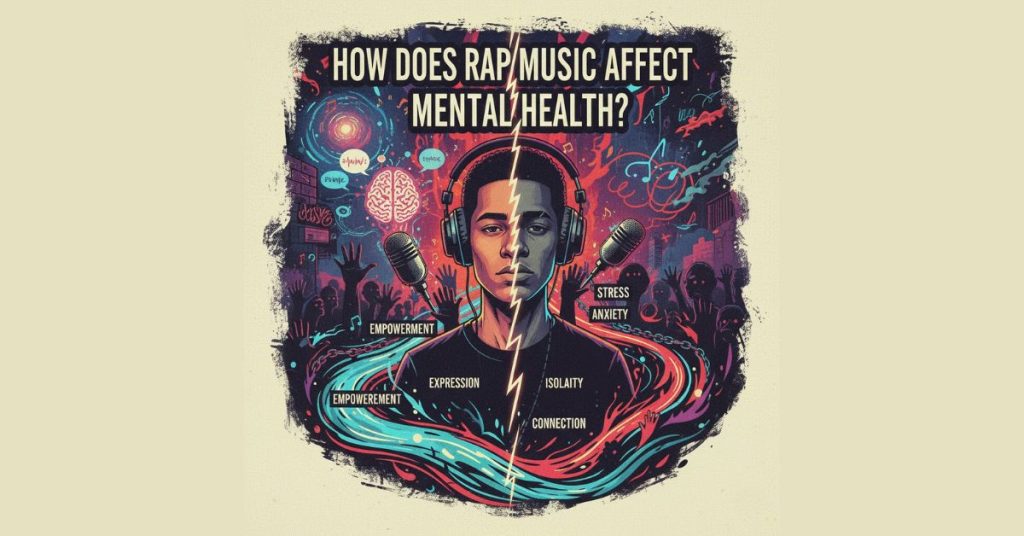
Look, we’ve all been there. You are scrolling through your phone and somehow feeling some kind of way, it is 2 AM and you hear Kendrick Lamar playing in a different way. Or perhaps you are energized having listened to some violent bars and you are now ready to take on the world. How does rap music affect mental health? It is a question that has been creating nightmares among researchers, therapists, and quite frankly, music lovers, we.
And this is where everybody does not want to acknowledge the fact that there is no simple answer. It is not sunshine and clouds all the time and neither is it doom and gloom all the time. On the verge of the year 2026, the topic of rap and mental health has turned into one of the most interesting discussions in the field of music and psychology.
The Science Behind The Bars
Here is where it gets interesting. The University of North Carolina conducted a study of the 25 best rap songs between 1998 and 2018 and the results were insane. The mentions of depression, suicide, mental health struggle increased more than twice over that 20 years time. This was colossal, we are not talking of a small rise.
How does rap music affect mental health when artists are literally opening up their diaries and setting them to beats? According to the study, 78 percent of rappers who talked about mental health are black males with an average age of mid-twenties. These artists were not just creating music; they were working through trauma, violence and systemic problems that have not been thought of by the majority of the population.
The crazy part? Brain scans indicate that rap activates of emotion, motor functions, nerve functions, and overall motivation functions. When you are vibing to a song your brain is literally like a Christmas tree in parts of the brain that relate to the process of feelings and creativity.
When Rappers Became Therapists
In 2016, Kid Cudi defied the rules and went to rehab with depression and suicide. But he did not do it behind his back, he posted about it, he discussed it, and he brought his struggle into the limelight. The hashtag that came after it was #YouGoodMan, not only was it trending, but it was generating real discussions within the Black male community who have been told to quietly take their punishment their whole lives.
In 2015, Kendrick Lamar directly rapped that he had been living with depression since he was a teenager on the album “To Pimp a Butterfly” with this song. No metaphors, no evading wordplay, plain old honesty. The number 1-800-273-8255 known as the suicide prevention hotline literally in the song 1-800-273-8255 was a massive success and allegedly increased the amount of people calling the hotline by a substantial number.
A case in point, Big Sean became quite open talking about it when his friend killed himself because he discovered that he had been focusing on the needs of other people to the point where he was not paying sufficient attention to his own state of mind. They are not short-lived cases any longer. Moving forward through 2026, vulnerability in rap is no longer viewed as weakness, but it is the new flex.
The Double-Edged Sword Nobody Talks About
But let’s keep it real for a second. How does rap music affect mental health when some tracks literally end with gunshots and detailed descriptions of suicide? Suicidal thoughts by The Notorious B.I.G. is a force, and researchers caution that there is this phenomenon known as Werther Effect, when exposure to suicide through media may stimulate a copycat action in the listeners who are already at a risk.
Such is the unpleasant fact. Not every mental health allusion in rap works. Certain songs promote self-destruction, accept substance abuse as a normal coping habit, or glorify depression in a manner that may aggravate the condition of the audience. The whole discography of Future, though great musically, tends to depict drug use as a sole solution of dealing with emotional pain.
The boundary between healthy self-expression and potentially damaging content is much narrower than we would prefer it to be. With streaming numbers still prevailing in our success measurement spectrum in 2026, the issue of responsibility versus artistic freedom is a genuine question.
Hip-Hop Therapy Is Actually A Thing Now
Stop here while you consider that this is yet another theoretical argument, but therapists are literally applying rap in clinics as we speak. It is referred to as Hip-Hop Therapy and it is really getting serious with us moving further into 2026. To decode mental health issues, counselors are making their clients write their lyrics, freestyle on how they feel, and breakdown of songs.
Research on the topic that appeared in 2024 indicated that youths, and more so, marginalised groups, find rap music affect mental health interventions more culturally appropriate and relatable than traditional talk therapy. They are writing lyrics on emotive subject matter, talking about Hip-Hop songs and doing therapeutic beat-making.
The results? Greater emotional sensitivity, empowerment, and improved processing of troublesome emotions. This was supported by a systematic review of 10 Hip-Hop and rap well-being intervention studies published between 2011 and 2022 supported by strong data. Moving forward to 2026 and beyond, the Hip-Hop Therapy programs will continue to spread in the schools, community centers, and professional counseling facilities.
The Future Is Looking Different
As we navigate through 2026, the conversation around how does rap music affect mental health is evolving fast. There is an increasing amount of artists who are openly discussing therapy – Jay-Z has famously stated that he grew so much after therapy because of the experience he had, giving it a huge co-sign that would not have been imaginable in previous decades of hip-hop.
Recently, Mental Health America has raised the awareness of Hip-Hop Therapy as a new revolutionary type of therapy that brings together the blunt force of rap and conventional therapeutic methods. They are referring to it as the sixth component of hip-hop culture – health and healing, to compliment the five traditional components (rapping, deejaying, graffiti, breakdancing, and beatboxing).
The streaming age ensures that artists are able to release the songs which work with their mental health in real-time and almost it is a therapy session in front of people. SZA has recently discussed her diagnosis with severe depression and how she was at the same time becoming one of the largest performers in the world. The way mainstream debates about mental health in rap have become is evidenced by her work with Kendrick Lamar on songs such as “Luther.”
What This Means For Listeners
Here’s the bottom line for 2026 and beyond: How does rap music affect mental health? It will be completely a matter of how you interact with it and what you are listening to. It has been found that rap can decrease the stigma of mental illness, promote help-seeking behavior, and provide validation of individuals with similar problems. Music can indeed trigger your nervous system to relax when you listen to it, because of its rhythm and repetitive nature.
But context matters. You may be making it worse in case you are already in a dark place and overindulging yourself with the songs that celebrate the power of destroying things. The trick is to find out artists who are neither corrupted nor cynical, those rappers who do not simply narrate the darkness but also discuss how to find some light, how to receive assistance, and how to recover.
Recent research has established that listeners of rap are in a better position to cope with mental health problems as compared to others. The genre highlights toughness, community expertise, and self-empowerment, which the conventional therapy lacks at times, particularly in communities of the marginalized that have mental health barriers.
The Reality Check
There is a real trend that is taking place when we consider the direction rap is going in the year 2026. In spite of his scandals, Drake has rapped about being lonely and how money cannot cure depression. The new generation of artists who include all of Baby Keem through Denzel Curry is putting mental health discussion as part of their brand.
Projects exploring how does rap music affect mental health are getting serious funding. It is being researched in research institutions. There is certification of therapists in the Hip-Hop Therapy techniques. It is being integrated in school wellness. It is not a fad, it is a paradigm shift in our ways of thinking about rap music and mental health care.
Artists who are creating massives in 2026 realize that there is something very important that their young fans are facing and that is experiencing anxiety, depression, and mental health crisis like never before. They are not only making good music by opening up, but they are saving lives as well. When your favorite rapper tells you he has been there then it sinks even deeper than any inspirational poster or general tips ever will.
Moving Forward
The question isn’t really whether rap music affects mental health anymore – we know it does. The actual question is how do we make the most out of the positive effects and at the same time be sincere about the possible dangers. We are witnessing a cultural revolution right before our eyes as streaming sites create technology that warns users of the content they are watching, more artists become comfortable with being vulnerable and Hip-Hop Therapy is becoming more popular.
The year 2026 is coming out to be a defining year. The Grand National Tour of Kendrick Lamar with SZA is being touted as the highest-grossing co-headlining tour of all time, and both the artists are mental health advocates. Kid Cudi has recently published his pop album called Free and continues his activity as a Mental Health Ambassador. The discussion is not slacking off, it is gaining momentum.
So yeah, how does rap music affect mental health? In some of the ways that we are yet to learn and in some of the ways that are deeply personal and in ways that may transform the whole approach to mental wellness within marginalized communities. The raps are continuing to drop, the talking is continuing to happen and frankly? That’s exactly what we need.